Lock in Your Smile with Permanent Implant Dentures
When Missing Teeth Feel Like a Dead End — There's a Better Way
Permanent false teeth are non-removable tooth replacements anchored to dental implants — and they're one of the most life-changing solutions in modern dentistry. Here's a quick overview:
Feature What to Know What they are Implant-supported dentures fixed in your mouth permanently Who removes them Only a dentist can — you cannot take them out yourself Best for People missing most or all teeth who want a stable, long-term solution How long they last The implants themselves can last a lifetime with proper care vs. regular dentures No slipping, no nightly removal, better chewing and speech
Losing teeth doesn't just affect how you look. It changes how you eat, how you speak, and — over time — even the shape of your face. That's because once teeth are gone, the jawbone underneath begins to shrink. Traditional removable dentures can help fill the gap, but they don't stop that bone loss, and they come with real daily frustrations: slipping mid-sentence, clicking when you chew, or simply feeling insecure about your smile.
Permanent false teeth change that equation entirely.
They sit fixed in your mouth, anchored to titanium implants that fuse with your jawbone. No adhesive. No nightly soaking. No worrying they'll shift at dinner.
This guide walks you through everything you need to know — from how they work, to who qualifies, to what the procedure actually involves.
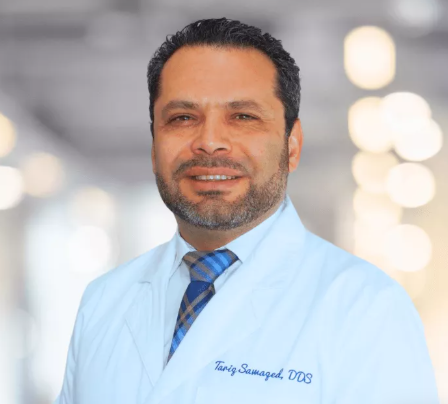
I'm Dr. Tariq Sawaqed, a cosmetic and implant dentist with over 20 years of experience helping patients restore their smiles with permanent false teeth at Arvada Implants and Cosmetic Dentistry in Colorado. Having placed hundreds of implant-supported restorations using advanced 3D imaging and guided implant planning, I'll give you an honest, clear picture of what to expect — so you can decide if this is the right path for you.
Understanding Permanent False Teeth and How They Work
To understand how permanent false teeth work, it helps to look at what happens beneath the surface when you lose a tooth. Your natural teeth do more than just chew; their roots stimulate your jawbone, signaling to your body that the bone is still needed. When those roots are gone, the body begins to resorb the bone tissue. Over time, this bone loss leads to what dentists call facial collapse — a sunken-in look around the cheeks and mouth that can make you look much older than you are.
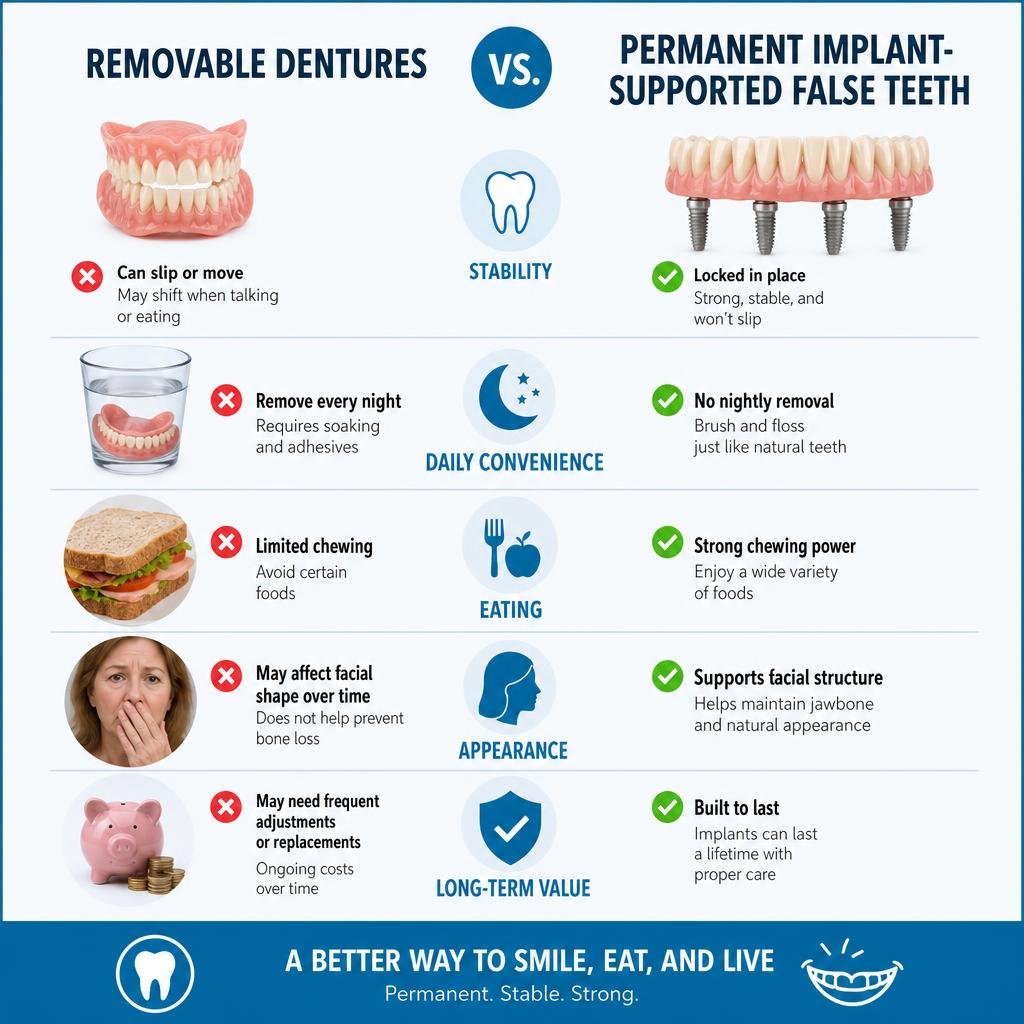
Traditional removable dentures sit on top of the gums. While they look like teeth, they do nothing to preserve the jawbone. In fact, the constant rubbing and shifting of a loose denture can actually accelerate bone loss.
Permanent implant dentures solve this problem by replacing the tooth roots. According to Cleveland Clinic research on denture alternatives, utilizing implants to support a prosthetic arch is the only way to completely stabilize the bone structure and prevent facial collapse.

What Are Permanent False Teeth?
When we talk about permanent false teeth, we are referring to a non-removable dental prosthesis. Unlike traditional dentures that you pop out before bed, these are securely fastened to dental implants.
Often called hybrid dentures or fixed implant-supported dentures, this system uses a customized acrylic, porcelain, or zirconia arch containing a full set of beautiful, natural-looking teeth. This arch is screwed directly onto titanium posts (implants) that have been surgically placed into your jawbone.
Because they are screwed in, they can only be removed by a dental professional during your routine deep cleanings. To explore how these differ from standard plates, you can read our comparison of Post/Dentures Vs Implants.
Types of Permanent Dentures Available
Not all permanent restorations are created equal. Depending on your oral health, bone density, and budget, we offer a few advanced options:
Implant-Supported Fixed Dentures (Hybrid Dentures): This is the gold standard for non-removable teeth. A custom-milled bar (usually made of titanium or zirconia) is covered with realistic acrylic or porcelain teeth. It is screwed directly into four to six implants per arch.
All-on-4® Treatment: This specialized technique strategically angles four dental implants to maximize the use of available bone, often eliminating the need for expensive bone grafts. It allows us to provide a fully fixed, temporary set of teeth on the very same day as your surgery. Learn more about how this works on our Dental Implants/All On 4 page.
Implant-Retained (Snap-In) Dentures: While these are incredibly stable, they are actually removable. They snap onto implant locators but must be taken out at night. If you are debating between these two approaches, we break down the key differences in our guide on Snap In Dentures Vs All On 4 Implants.
Zirconia Implant Bridges: For the ultimate in durability and natural aesthetics, zirconia is the premium material of choice. It is highly resistant to staining, chipping, and wear. See our breakdown of Post/Hybrid Dentures Vs Implants to compare these materials.
The Benefits of Permanent False Teeth Over Removable Options
The transition from removable plates to permanent restorations is like trading in a bicycle for a sports car. The stability, comfort, and confidence they provide cannot be overstated.
Feature Traditional Removable Dentures Permanent Implant Dentures Stability Slips, slides, requires messy adhesives Firmly anchored; will never move or fall out Chewing Power Restored to about 20-30% of natural bite Restored to 90%+ of natural bite force Taste & Comfort Covers the roof of the mouth, dulling taste Leaves the palate open; fully natural feel Bone Health Accelerates jawbone shrinkage Stimulates and preserves the jawbone Maintenance Must be removed daily and soaked overnight Brushed and cleaned just like natural teeth
Beyond the structural benefits, the emotional impact is profound. Imagine going out to a restaurant in Arvada and ordering a thick steak or a crisp apple without a second thought. Imagine laughing heartily at a joke without instinctively putting your hand over your mouth to catch a slipping denture.
By restoring your bite force and leaving the roof of your mouth uncovered, you can taste your food fully and speak with absolute clarity. For a deeper look at your options, check out our Post/Complete Guide Full Partial Dentures 2026.
Who Is a Candidate for Permanent False Teeth?
Most adults who are missing multiple teeth or facing total tooth loss are excellent candidates for permanent false teeth. However, because these prosthetics rely entirely on dental implants, there are a few key requirements:
Adequate Bone Density: Your jawbone must have enough volume and density to support and anchor the titanium posts. If you have been missing teeth for a long time, you may have experienced bone loss.
Good Systemic Health: Since dental implant placement is a surgical procedure, candidates must be healthy enough for minor surgery. Conditions like uncontrolled diabetes or active periodontal disease must be managed first.
No Smoking (or willingness to pause): Smoking significantly interferes with the bone's ability to heal around the implants.
If you lack sufficient bone, don't worry. Advanced preparatory procedures like bone grafting or a sinus lift can rebuild the bone structure to create a solid foundation. You can read about how we prepare your mouth for successful implants in our guide to Post/Dental Implant Preparation.
The Surgical Procedure and Recovery Timeline
Getting permanent implant dentures is a journey, but with modern technology and sedation options, it is highly predictable and comfortable.
Step-by-Step Placement Process
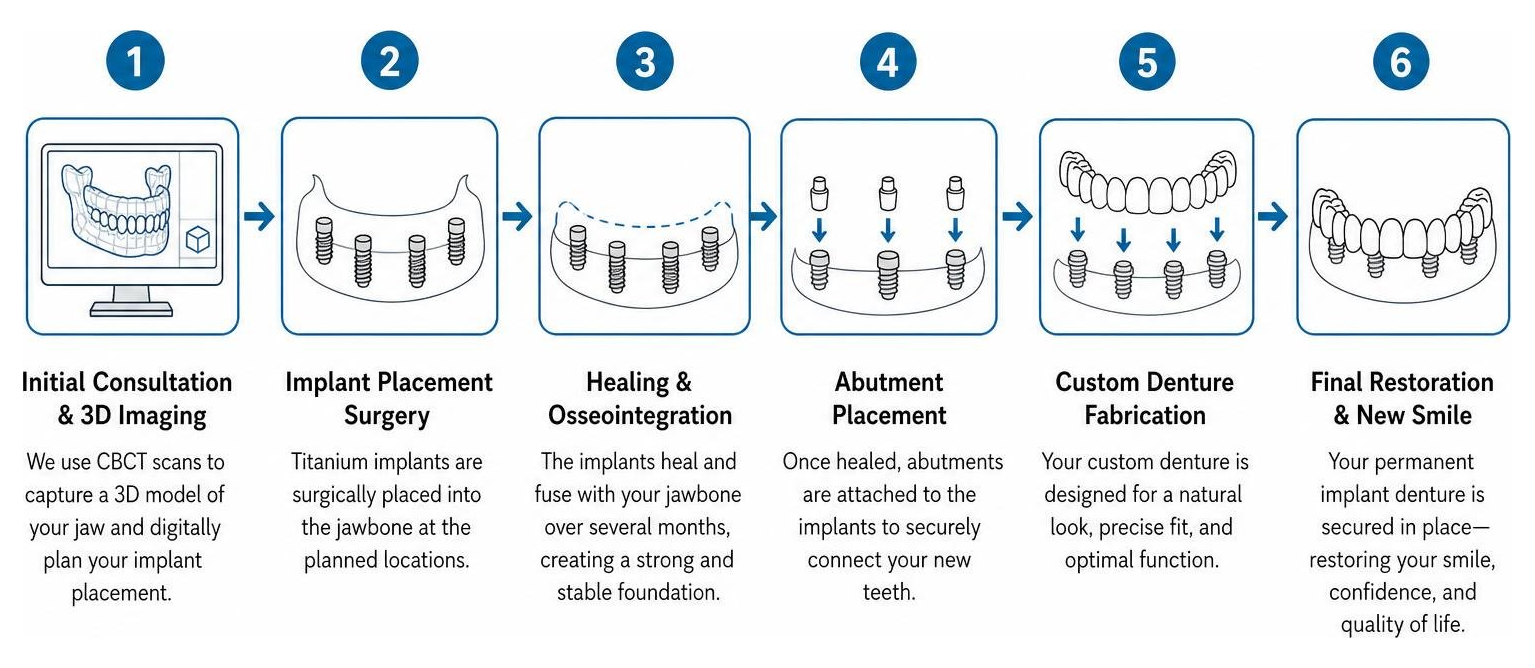
The process of receiving your new smile is completed in highly organized phases:
Initial Consultation & 3D Imaging: We use advanced Cone Beam CT (CBCT) scans to capture a 3D model of your jawbone, nerves, and sinus cavities. This allows us to digitally plan the exact placement of each implant before your surgery even begins.
Surgical Phase (Implant Insertion): On the day of surgery, any remaining failing teeth are gently extracted. Next, the titanium implants are precisely placed into the jawbone. If we are performing an All-on-4 or similar immediate-load procedure, we will attach a beautiful, temporary fixed acrylic bridge so you never have to walk out of our clinic without teeth. Read a detailed breakdown in Post/Dental Implant Procedure Steps.
Osseointegration (The Healing Window): Over the next three to six months, your jawbone will naturally grow around and fuse with the titanium posts. This biological fusion is called osseointegration, and it is what makes dental implants so incredibly strong. For a detailed look at this phase, see our Post/Dental Implant Process Step By Step guide.
Final Custom Fitting: Once healing is complete, we take digital impressions of your mouth to design your final, ultra-durable custom permanent arch. This is screwed into place, leaving you with a flawless, rock-solid smile.
Recovery and Healing Expectations
Most patients are surprised by how manageable the recovery is. While you will experience some mild swelling, bruising, and tenderness for the first few days, this is easily managed with prescribed or over-the-counter pain medication.
During the first couple of weeks, you will need to stick to a soft-food diet to avoid putting too much pressure on the healing implants. Think smoothies, scrambled eggs, mashed potatoes, and yogurt. To help you plan your recovery, we have compiled a list of the Post/Best Recovery Foods and a detailed Post/Dental Implant Recovery Timeline to keep your healing on track.
Lifespan, Maintenance, and Daily Care
To protect your investment and keep your mouth healthy, it is essential to understand how to care for your new smile and what to expect regarding its longevity.

How Long Do Permanent Dentures Last?
There is a massive difference in lifespan between traditional prosthetics and implant-supported systems:
Traditional Dentures: The average lifespan of a traditional denture is seven to 10 years. Because your jawbone constantly changes shape, most people will need replacement dentures or a professional denture reline every one to two years to maintain a secure fit.
Dental Implants: According to WebMD research on dental implant lifespan, dental implants can last a lifetime with proper care. The titanium posts fuse permanently with your bone.
The Prosthetic Arch: The customized teeth screwed onto those implants typically last 10 to 15+ years before needing cosmetic refresh or minor maintenance, depending on the material used (acrylic vs. zirconia) and how well you care for them.
Cleaning and Maintenance Best Practices
Even though your new teeth cannot get cavities, keeping them clean is vital to prevent gum inflammation and a condition called peri-implantitis (an infection of the bone surrounding the implants).
Because you cannot remove your permanent false teeth, you will clean them directly in your mouth:
Brush Twice Daily: Use a soft-bristled toothbrush and a non-abrasive gel toothpaste. Standard whitening toothpastes are too abrasive and can scratch the acrylic or porcelain.
Use a Water Flosser: A water flosser is your best friend. It easily flushes out food particles trapped under the bridge.
Thread with Specialized Floss: Use a bridge aid or thick, spongy floss (like Super Floss) to clean the tiny space between your gums and the prosthetic arch.
Visit Us Regularly: You must visit us twice a year for professional cleanings. We will check the integrity of the implants, clean the hard-to-reach areas, and ensure your gums remain perfectly healthy.
Review our comprehensive Implants Home Care Instructions for a complete step-by-step daily checklist.
Comparing Permanent Dentures to Other Tooth Replacement Options
If you are exploring ways to rebuild your smile, you've likely come across various options. Let's see how permanent implant dentures stack up against the alternatives.
Permanent Dentures vs. Dental Bridges
A traditional dental bridge is an excellent solution for replacing one or two missing teeth in a row. However, a bridge requires us to grind down the healthy neighboring teeth to act as anchors for the crowns.
If you are missing a full arch of teeth, a dental bridge is simply not structurally viable. Permanent implant dentures restore the entire arch without altering or damaging any remaining natural teeth. For a side-by-side breakdown of these two methods, visit our article on Post/Dental Bridge Vs Implant.
Permanent Dentures vs. Traditional Removable Dentures
Traditional dentures rest loosely on your gums, held in place by natural suction or messy adhesives. They are prone to slipping, can cause painful sore spots, and must be removed for at least eight hours a day to let your gums rest and prevent bacterial buildup.
Permanent dentures, on the other hand, behave exactly like real teeth. They stay in your mouth 24/7, protect your bone from deteriorating, and allow you to eat whatever you want. For a thorough comparison of comfort, lifestyle, and functionality, read our guide on Post/Dentures With Dental Implants. For broader tooth replacement options, browse through our general guide on Post/Tooth Replacement.
Frequently Asked Questions About Permanent Dentures
Can you sleep with permanent dentures in?
Yes, absolutely! Because your permanent dentures are securely screwed onto your dental implants, you do not—and cannot—remove them at night. You sleep, wake up, and go about your day with your teeth permanently in place. This is a massive psychological and physical benefit for patients who dislike the idea of being seen without their teeth.
What are the main risks or drawbacks of permanent dentures?
As with any surgical procedure, there are a few risks to keep in mind:
Surgical Risks: These include minor risks of infection, bleeding, or temporary nerve irritation, though these are highly rare with modern 3D guided surgery.
Peri-implantitis: If daily oral hygiene is neglected, bacteria can accumulate around the implants, leading to bone loss and potential implant failure.
Upfront Cost: Permanent implant solutions require a higher initial investment compared to removable options.
How much do permanent dentures cost compared to traditional ones?
Traditional dentures have a lower upfront cost but require ongoing expenses, including regular relines every one to two years, specialized adhesives, cleaning solutions, and complete replacement every seven to 10 years.
Permanent implant dentures require a larger upfront investment because they involve surgical implant placement, custom-milled substructures, and highly advanced materials. However, because they preserve your jawbone and can last a lifetime, they are widely considered the most cost-effective, long-term investment in your health and quality of life. We break down the financial side in detail in our post on Post/Dentures Vs Implants Cost.
Conclusion
Living with missing teeth or loose, uncomfortable dentures can feel exhausting. But you don't have to compromise on your self-esteem, your health, or your ability to enjoy your favorite foods.
At Arvada Implants and Cosmetic Dentistry in Arvada, Colorado, we specialize in helping our patients transition seamlessly to beautiful, lifelike, and rock-solid permanent false teeth. Our dedicated team, led by Dr. Tariq Sawaqed, combines state-of-the-art dental technology with custom, in-house lab creations to design a smile that is uniquely yours.
If you are ready to stop worrying about your teeth and start living your life to the fullest, we invite you to take the first step. Contact us today to schedule your personalized consultation and explore our options for Full Partial Dentures and permanent implant solutions. Let us help you lock in a smile you'll love showing off!