Making a Good Impression Without Breaking the Bank in Colorado
Why the Implant Digital Impressions Price in CO Matters Before You Commit
Understanding implant digital impressions price CO patients face is one of the smartest first steps you can take before starting your implant journey. Here is a quick snapshot of what to expect:
Impression Type Typical Patient Cost Notes Digital impression (intraoral scan) $0 – $300 per arch Often bundled into implant treatment fee Traditional physical impression $50 – $200 per arch Material and lab shipping costs apply 3D photographic image (D0351) ~$250 Used for digital planning; CO state benchmark CBCT scan (both jaws, D0367) ~$324 Required for guided implant planning
Note: Digital impression fees are frequently included in the total implant cost rather than billed separately.
Colorado implant pricing runs roughly 3–5% above the national average, with Denver Metro at the top end. A complete single-tooth implant averages $4,650 statewide in 2026, and digital scanning technology is now a standard part of that workflow at most modern practices — not an expensive add-on.
The good news? Switching to digital impressions often saves money over time by cutting lab shipping fees, reducing remakes, and shortening appointment times. But the details matter, and that is exactly what this guide breaks down.
I am Dr. Tariq Sawaqed, founder of Arvada Implants and Cosmetic Dentistry, and after more than 20 years of clinical experience — including building fully digital implant workflows using 3D imaging, guided surgery, and intraoral scanning — I have helped thousands of Colorado patients navigate implant digital impressions price CO questions with confidence. Let me walk you through everything you need to know to make a smart, informed decision.
Understanding the Implant Digital Impressions Price CO
To understand why the implant digital impressions price CO clinics charge is structured the way it is, we have to pull back the curtain on the technology itself. Dental practices must make a significant capital investment to bring intraoral scanners into their offices.
High-end, premium scanners like the Dentsply Sirona Primescan or the iTero Element 5D can easily cost upwards of $35,000 to $40,000 initially. On top of that, many of these premium systems require ongoing monthly subscription fees, software licensing, and mandatory maintenance fees to keep their cloud-native systems (like DS Core) active.
Fortunately, the rise of open-source and budget-friendly scanners has disrupted the market. Highly accurate, mid-range scanners like the Medit i700 can be purchased for under $20,000 with no monthly subscription fees, allowing cost-conscious practices to pass those savings directly on to their patients.
Below is a breakdown of how the hardware costs vary across the industry:
Scanner Brand & Model Estimated Initial Capital Cost Ongoing Monthly Software/Licensing Fees Key Features Dentsply Sirona Primescan $35,000+ Yes (DS Core integration) Gold standard for chairside milling; cloud-native iTero Element 5D $34,000+ Yes Near-Infrared Imaging (NIRI); great for orthodontics 3Shape TRIOS 5 $18,900+ Optional Excellent ergonomics, highly precise Medit i700 $13,500 – $18,000 None Extremely popular, open-format STL export, highly accurate Budget Imports (e.g., Alliedstar) $5,000 – $10,000 None Entry-level pricing, fast scanning speeds
Because we carefully manage our overhead and choose technology that balances peak performance with fiscal responsibility, we can keep our treatment costs highly competitive for families in Arvada and the surrounding Denver metro area.
What is the average implant digital impressions price CO patients can expect?
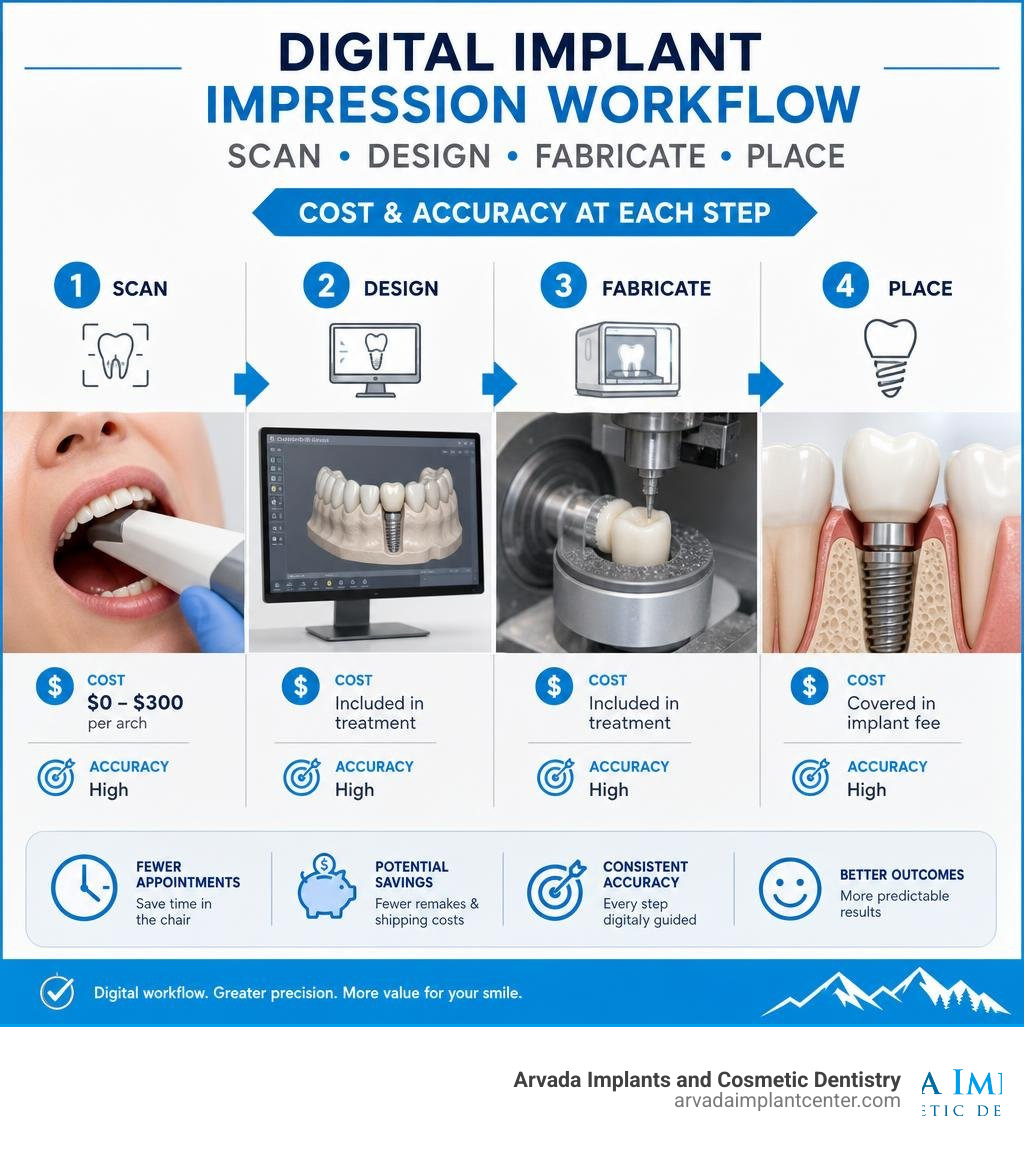
When you look at your overall treatment plan, you might wonder how much of your hard-earned money is going directly toward the digital scanning process. On average, if billed as an independent diagnostic fee, an intraoral digital impression scan ranges from $150 to $300 per arch.
However, in our practice, we rarely bill digital impressions as a standalone line item. Instead, we bundle the cost of intraoral scanning directly into our comprehensive surgical and restorative packages. This means you do not have to worry about getting nickeled-and-dimed every time we scan your mouth to check your healing progress.
When planning your budget, it is helpful to look at the entire picture. For instance, you can find more info about the cost of one dental implant to see how diagnostic fees, implant posts, custom abutments, and final crowns combine to form your total investment.
How does the implant digital impressions price CO compare to traditional molds?
In the past, the only way to capture the shape of your teeth and the exact position of an implant was to load a metal or plastic tray with a thick, cold, gooey silicone putty (like polyvinyl siloxane, or PVS) and press it against your teeth. If you have a sensitive gag reflex, you already know this process can feel like a mild form of torture.
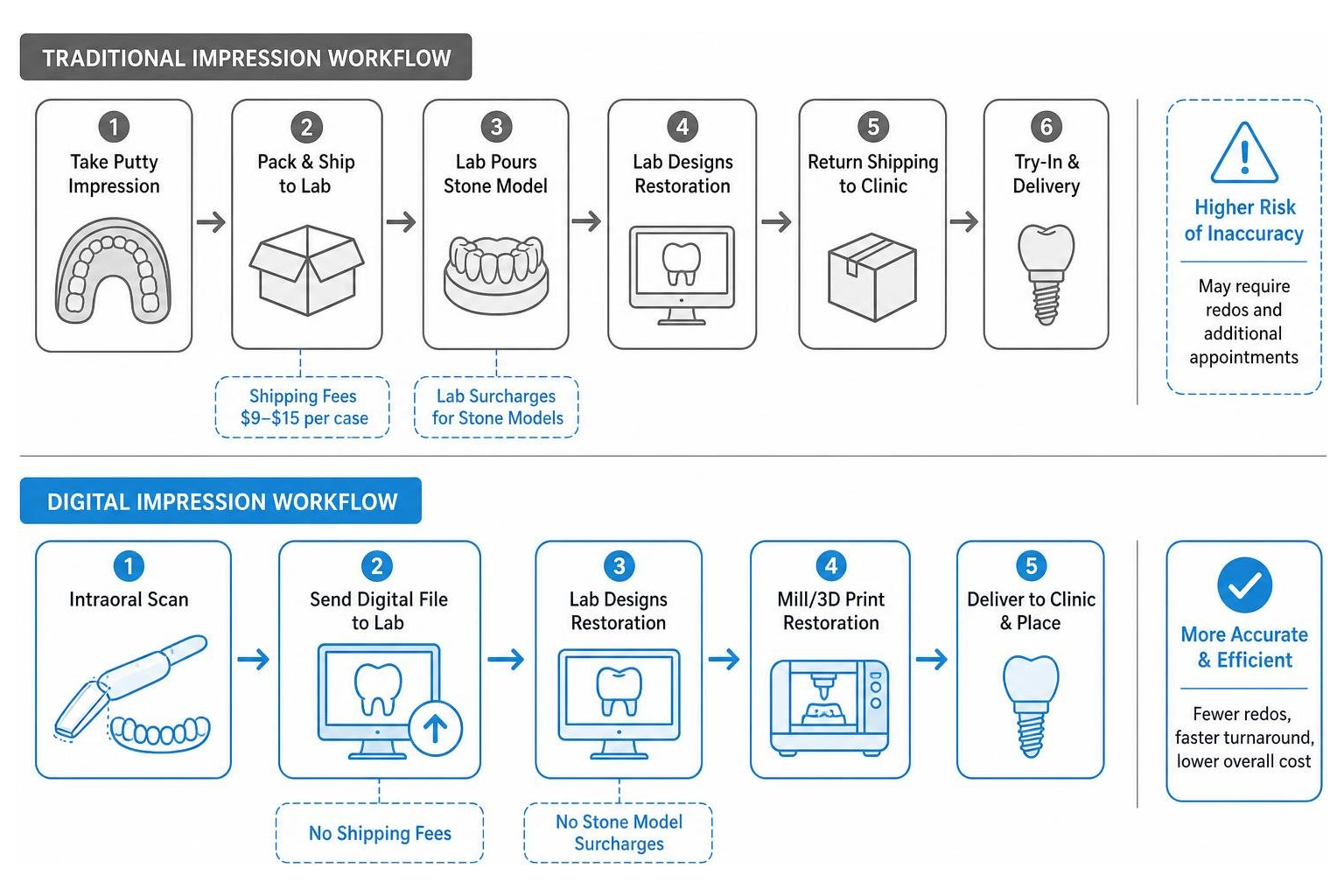
From a pure cost perspective, traditional molds might seem cheaper upfront. A container of PVS putty and a disposable tray only cost a clinic about $15 to $30 in raw materials. However, traditional impressions carry heavy hidden costs:
Shipping Fees: Physical molds must be packed in protective boxes and shipped via courier to a dental laboratory, which adds roughly $9 to $15 per case in outbound shipping.
Inaccuracy Redos: Putty can pull, warp, or bubble. If the mold is even slightly distorted, the final implant crown will not fit. The patient has to be recalled, and the entire process must be repeated at the clinic's expense.
Lab Surcharges: Many dental labs charge a premium to manually pour plaster stone models from physical impressions.
When you factor in these variables, the long-term efficiency of digital scanning makes it incredibly cost-effective. If you want to see how these dynamics play out across the state, you can read more about the Colorado Dental Implant Cost (2026) to compare regional averages and see why digital integration has become a major driver of affordable care.
Digital vs. Traditional: A Cost-Benefit Analysis

When we compare digital intraoral scanning with physical putty molds, the differences are night and day. A digital workflow replaces physical shipping with the click of a button. Once we capture a 3D model of your mouth, we instantly export the file to our laboratory partner.
This digital transition completely eliminates physical shipping fees and cuts lab turnaround times in half. Instead of waiting two to three weeks for a lab to pour stone, design a crown, and ship it back, digital files can be processed by lab technicians within minutes of your scan.
In fact, many advanced dental laboratories offer direct discounts of $20 to $40 per unit to dental practices that submit cases digitally. Because we do not have to pay for shipping or physical model materials, we can pass these operational savings directly back to you. If you are curious about how this fits into the overall timeline of your care, check out more info about dental implant procedure steps.
Lab Fees and Material Savings
The wholesale savings behind digital dentistry are substantial. In a traditional workflow, a dental lab must fabricate a physical stone model, manually place an implant analog, and cast a custom metal abutment.
In a fully digital workflow, the lab uses the intraoral scan data to virtually design a custom titanium or hybrid zirconia abutment and a screw-retained zirconia crown. According to the Hiossen Digital Center Price List, a custom titanium abutment designed and fabricated digitally lists for around $190, but can drop as low as $113 for high-volume digital packages. Similarly, a digital zirconia screw-retained crown package can be sourced at a wholesale rate of $317 instead of the $500+ associated with traditional gold-cast restorations.
By leveraging these digital dental laboratory efficiencies, we can keep the cost of high-quality, custom-milled restorations incredibly affordable for our patients in Arvada.
Time Savings and Chair Time
Time is money—both for you and for us. Traditional impressions require a patient to sit with putty in their mouth for up to five minutes while the material chemically cures. If a mistake is made, the process starts over, doubling your appointment duration.
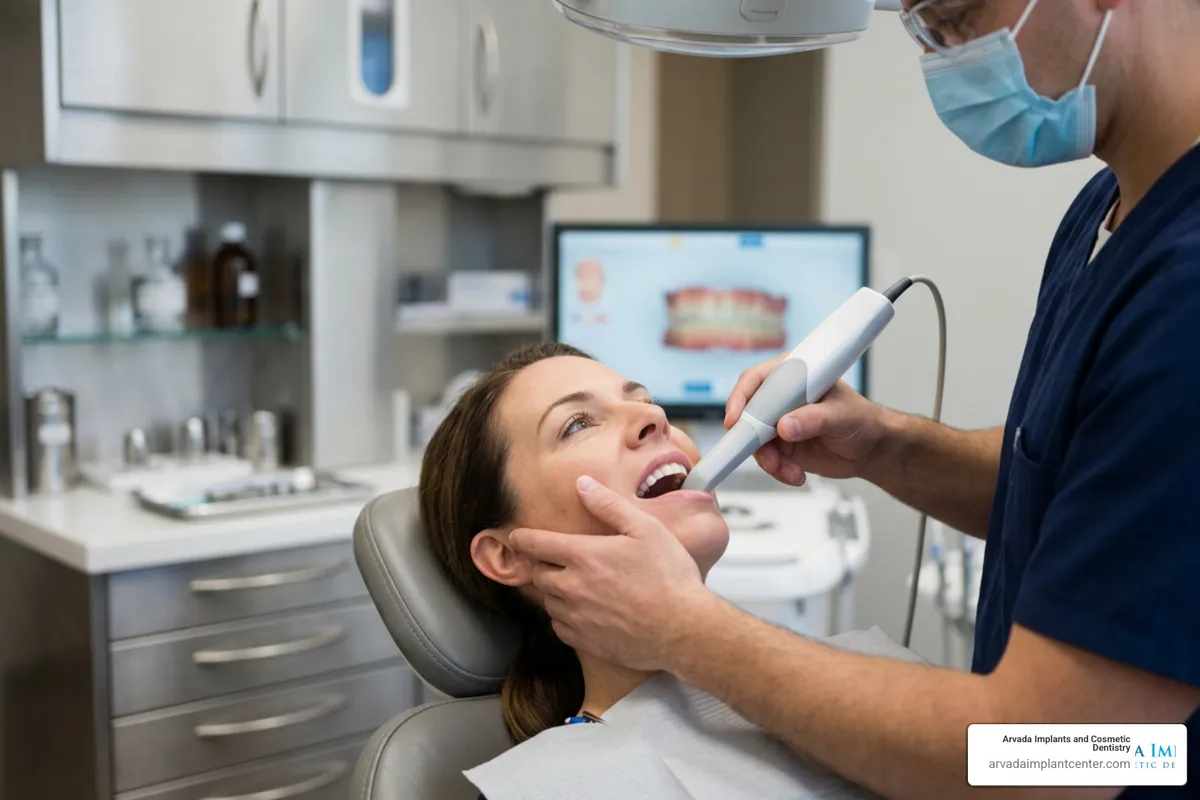
With an intraoral scanner, we can capture a highly detailed, full-arch 3D scan in under two minutes. Because the scanner displays the 3D model on a high-definition screen in real time, we can instantly verify that we have captured every necessary detail. If a small spot is missed, we simply wave the scanner wand over that specific area to patch the data, rather than retaking the entire impression.
This level of efficiency means you spend less time in the dental chair and require fewer appointments overall. For a complete look at how this fits into your schedule, review more info about the step-by-step dental implant process.
Clinical Accuracy and Long-Term Value
While saving money is important, your health and safety are our top priorities. The true value of digital impressions lies in their unmatched clinical accuracy.
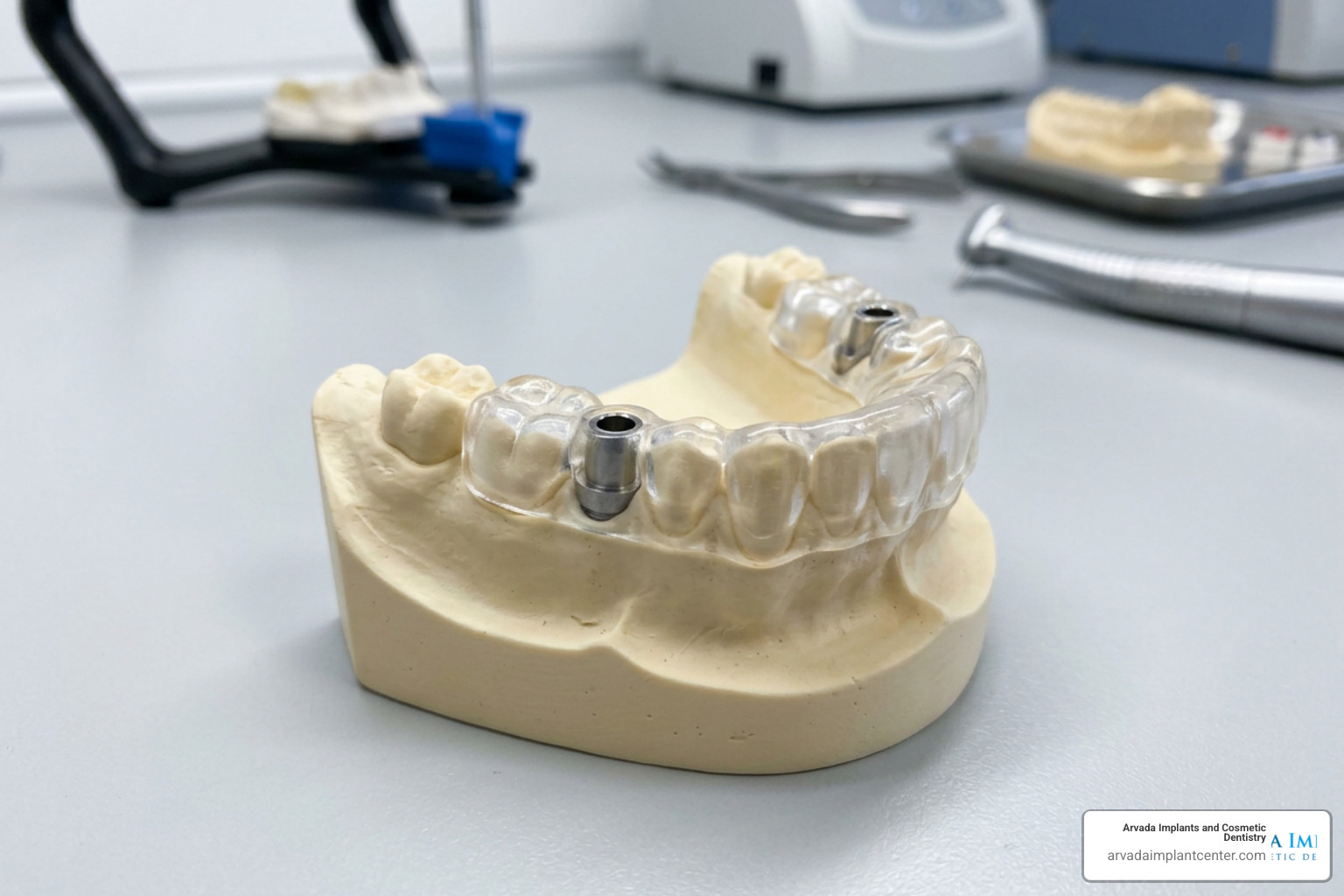
In implant dentistry, a fraction of a millimeter can mean the difference between a restoration that lasts for decades and one that fails prematurely. When an implant crown does not fit passively onto the implant body, it exerts constant, uneven lateral pressure on the surrounding bone. This can lead to:
Screws loosening or fracturing under the forces of chewing.
Micro-gaps that harbor bacteria, leading to gum inflammation and peri-implantitis.
Bone loss around the implant, which can ultimately cause the entire implant to fail.
By utilizing high-precision intraoral scanners, we achieve a level of passive fit that traditional physical materials simply cannot replicate. You can find more info about our technology to see how our digital ecosystem ensures your implants are placed and restored with micron-level accuracy.
Trueness and Precision in Implantology
To appreciate the clinical value of digital impressions, it helps to understand the difference between two scientific concepts: trueness and precision.
Trueness refers to how close a measurement is to the actual, true dimensions of the object being scanned. High trueness means the virtual 3D model is an exact mathematical replica of your mouth.
Precision refers to repeatability. A high-precision scanner will yield the exact same 3D model every single time, regardless of how many times you scan the area.
Scientific literature reviews show that modern digital scanners consistently deliver a level of trueness and precision that meets or exceeds conventional methods, with dimensional errors often staying well under 20 to 30 micrometers (microns) for localized areas. This extreme accuracy virtually eliminates the risk of biological and mechanical complications, saving you from expensive emergency visits and replacement procedures down the road.
Impact of Scan Body Height and Implant Depth
The accuracy of a digital implant impression depends heavily on the components used during the scan. When we take a digital impression of an implant, we attach a temporary post called a scan body (or scan adapter) directly to the implant. The scanner captures the shape, height, and orientation of this scan body so the software can calculate the exact 3D position of the implant buried beneath your gums.
Research published in leading scientific journals highlights several key clinical findings:
Implant Placement Level: Tissue-level implants (where the top of the implant sits flush with the gum line) generally yield higher scanning trueness and precision than bone-level implants (where the implant is buried deeper beneath the bone and tissue). This is because tissue-level implants offer superior visibility and accessibility, eliminating the challenges of subgingival scanning.
Scan Body Height: Shorter scan bodies actually result in higher trueness than longer scan bodies. A shorter distance between the scanner tip and the implant fixture minimizes leverage-related measurement distortions and virtual alignment errors.
State Fee Benchmarks: To put these high-tech diagnostic codes into perspective, the official Colorado DIDD Dental Fee Schedule sets regulated baseline rates for advanced 3D photographic imaging (CDT code D0351) at approximately $251 and CBCT 3D scans (D0367) at $324. These state-regulated rates show that high-precision digital planning is recognized as an essential, high-value component of modern reconstructive care.
Frequently Asked Questions
Does dental insurance cover digital impressions in Colorado?
In Colorado, dental insurance coverage for digital impressions varies by provider and plan. Most major insurers (such as Delta Dental of Colorado, Cigna, and Aetna) do not cover digital impressions as a standalone cosmetic or technology fee. Instead, they consider intraoral scanning to be a standard clinical method for capturing diagnostic data.
The scan is typically billed under diagnostic codes like D0351 (3D photographic image) or bundled directly into the restorative code for your final crown (such as D6058). If your plan covers 50% of the implant crown, the bundled digital impression cost is covered at that same rate.
To help make your treatment as stress-free as possible, our front office team will directly coordinate with your insurance provider to maximize your benefits. We also offer flexible, interest-free financing through partners like CareCredit to keep your care affordable. For more helpful tips, you can find more info about affordable dental implants.
Are digital impressions suitable for full-arch All-on-4 implants?
Yes, digital impressions are highly suitable and widely used for full-arch All-on-4 and All-on-6 restorations. However, scanning an entirely toothless (edentulous) arch can be challenging because there are no teeth to serve as natural reference points for the scanner's software.
To overcome this, we use specialized full-arch scan adapters (such as the DIRECTscan system) which feature large, flat reference surfaces. These adapters allow the scanner to stitch the images together with exceptional accuracy, ensuring a perfect, passive fit for your final full-arch zirconia bridge. To learn more about how this life-changing procedure works, read more info about All-on-4 implants.
How long does a digital impression scan take?
A digital impression scan is incredibly fast. A skilled dental assistant or clinician can complete a full-arch scan of your upper and lower teeth, including capturing your bite registration, in just 60 to 120 seconds.
Because the scanner captures natural colors and high-definition 3D details instantly, you do not have to wait for material to dry or sit uncomfortably with a tray in your mouth. It is clean, fast, and highly efficient.
Conclusion
Embracing digital dentistry is one of the best ways to experience a comfortable, highly accurate, and cost-effective dental implant procedure. By eliminating the messy putties, shipping delays, and manual lab errors of the past, modern intraoral scanning technology ensures your custom-milled restorations fit perfectly and last for years to come.
At Arvada Implants and Cosmetic Dentistry, we are proud to offer state-of-the-art digital workflows at a price that fits your family's budget. Our core mission is to provide affordable, highly personalized treatments with custom lab creations tailored to your unique smile. We never believe in one-size-fits-all solutions, and we work tirelessly to make sure your new teeth look, feel, and function just like natural ones.
If you are ready to take the next step toward reclaiming your smile with confidence, we invite you to contact us today. Let us show you how easy, precise, and affordable modern implant dentistry can be. For more details on our services, explore more info about dental implants and schedule your consultation with our friendly team in Arvada, Colorado.