Is the Clear Aligner 3D Imaging Fee Worth It?
What the Clear Aligner 3D Imaging Fee Actually Costs — and Whether It's Worth It
The clear aligner 3D imaging fee is one of the most misunderstood line items in orthodontic treatment — and for many patients, it shows up as a surprise after they've already agreed to a quote.
Here's a quick answer if that's what you're looking for:
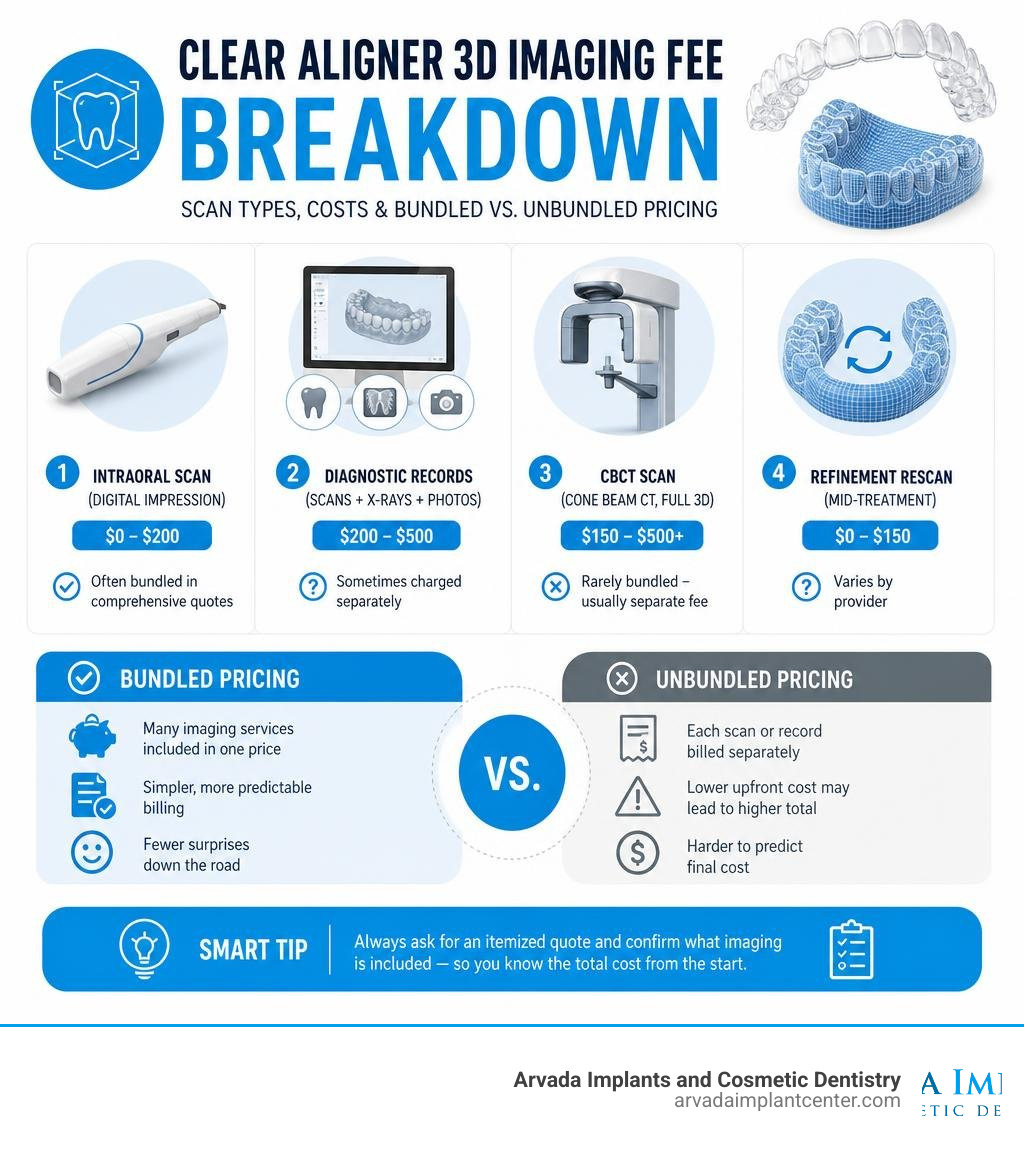
3D Imaging Type Typical Cost Usually Bundled? Intraoral scan (digital impression) $0 – $200 Often yes, in comprehensive quotes Diagnostic records (scans + X-rays + photos) $200 – $500 Sometimes charged separately CBCT scan (cone beam CT, full 3D) $150 – $500+ Rarely — usually a separate fee Refinement rescan (mid-treatment) $0 – $150 Varies by provider
The short version:
Most all-inclusive clear aligner quotes bundle a basic intraoral scan into the global fee
CBCT imaging is more often billed separately, since it requires specialized equipment
Always ask for an itemized quote — a lower upfront number doesn't always mean a lower final cost
Choosing clear aligners is exciting. But a quote that looks like $3,500 can quietly become $4,200+ once diagnostic records, mid-course correction scans, and retainers are added in. That's not fine print — it's just how orthodontic billing often works, especially when providers use unbundled pricing models.
Understanding exactly what your imaging fee covers — and what it doesn't — can save you hundreds of dollars and a lot of frustration.
I'm Dr. Tariq Sawaqed, a cosmetic dentist with over 20 years of experience at Arvada Implants & Cosmetic Dentistry, where I use advanced 3D imaging technology as a core part of every clear aligner 3D imaging fee discussion with patients. In the sections below, I'll break down every cost, explain the difference between scan types, and show you how to compare quotes the right way.
Understanding the Clear Aligner 3D Imaging Fee and What It Covers
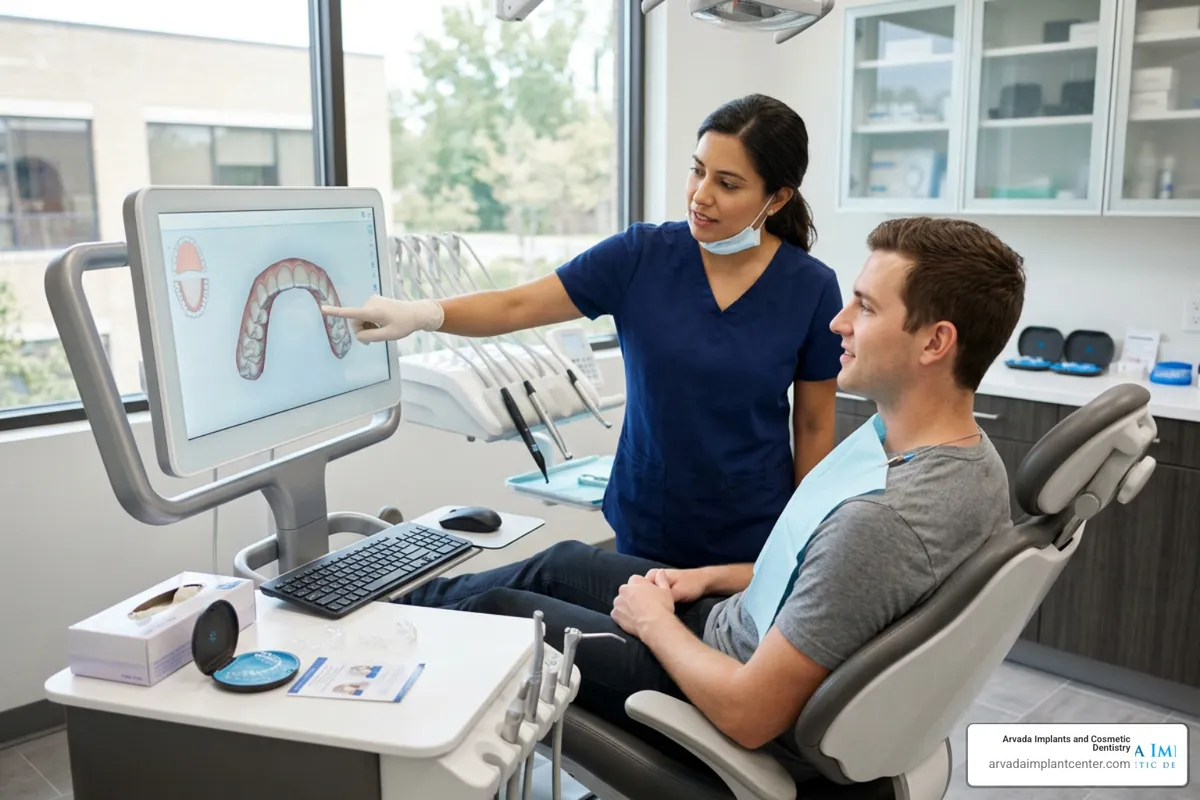
When you begin your journey toward a straighter smile, the first clinical step is capturing an exact model of your mouth. Historically, this meant biting down on trayfuls of cold, gooey dental putty. Today, we use state-of-the-art digital scanners to build a highly precise, three-dimensional digital model of your teeth.
The clear aligner 3D imaging fee represents the cost associated with capturing, processing, and utilizing these digital models. Far from being just a "photo fee," this charge covers several critical components of your diagnostic records and treatment planning:
Clinical Chair Time: The hands-on time required for a trained dental assistant or dentist to capture thousands of high-resolution data points in your mouth.
Equipment Overhead: Modern intraoral scanners are highly sophisticated medical devices. For example, standard commercial scanners can range from $12,400 to over $40,000, plus annual licensing and software subscription fees. The imaging fee helps offset the cost of maintaining this high-end technology.
Software Processing & Simulation: Specialized software processes the raw scan data to generate an interactive 3D model. We use this digital model to map out your entire treatment sequence, showing you a virtual "before and after" simulation before your first tray is even manufactured.
At our practice, we believe in utilizing the safest, most advanced diagnostic tools available. If you want to dive deeper into the specific equipment we use to make your visits faster and more comfortable, you can read more about our technology.

Types of 3D Imaging Used in Aligner Treatment
Not all 3D scans are created equal. Depending on your clinical needs, your provider may use different types of imaging technology. Understanding these differences is key to understanding why your clear aligner 3D imaging fee might vary from one office to another.
The two primary categories of 3D dental imaging are intraoral surface scans and Cone Beam Computed Tomography (CBCT) scans.
Feature Intraoral 3D Scans CBCT 3D Scans What It Captures Surface geometry of teeth and gums Entire jaw bone, tooth roots, sinuses, and airway Technology Used Optical cameras / light projection Low-dose 3D X-ray cone beam Radiation Exposure None Extremely low (less than a standard flight) Primary Purpose Creating physical aligner trays Evaluating bone density, root angles, and safety boundaries Average Cost Range $0 - $200 (usually bundled) $150 - $500+ (often unbundled)
Intraoral Scans vs. CBCT Scans
An intraoral scan is an optical surface scan. Think of it as a highly advanced video camera that stiches together thousands of rapid-fire images to create a digital "shell" of your teeth. It is incredibly accurate for capturing the crowns of your teeth, but it cannot see what lies beneath your gums.
A CBCT scan, on the other hand, is a specialized 3D X-ray. While an intraoral scan only shows us the visible portion of your smile, a CBCT scan allows us to look underneath the surface. It captures the entire "bone envelope," the exact positioning of your tooth roots, the density of your jawbone, and the location of your sinus floor.
When planning a clear aligner case, knowing how much bone support you have is crucial. Moving teeth too quickly or too far outside of their biological bone envelope can lead to permanent damage, gum recession, or tooth mobility.
Why Dental Providers Charge a Separate CBCT Clear Aligner 3D Imaging Fee
Many patients ask why they might have to pay an additional, separate fee for a CBCT scan when they’ve already received an intraoral scan. The answer comes down to clinical safety and advanced diagnostics.
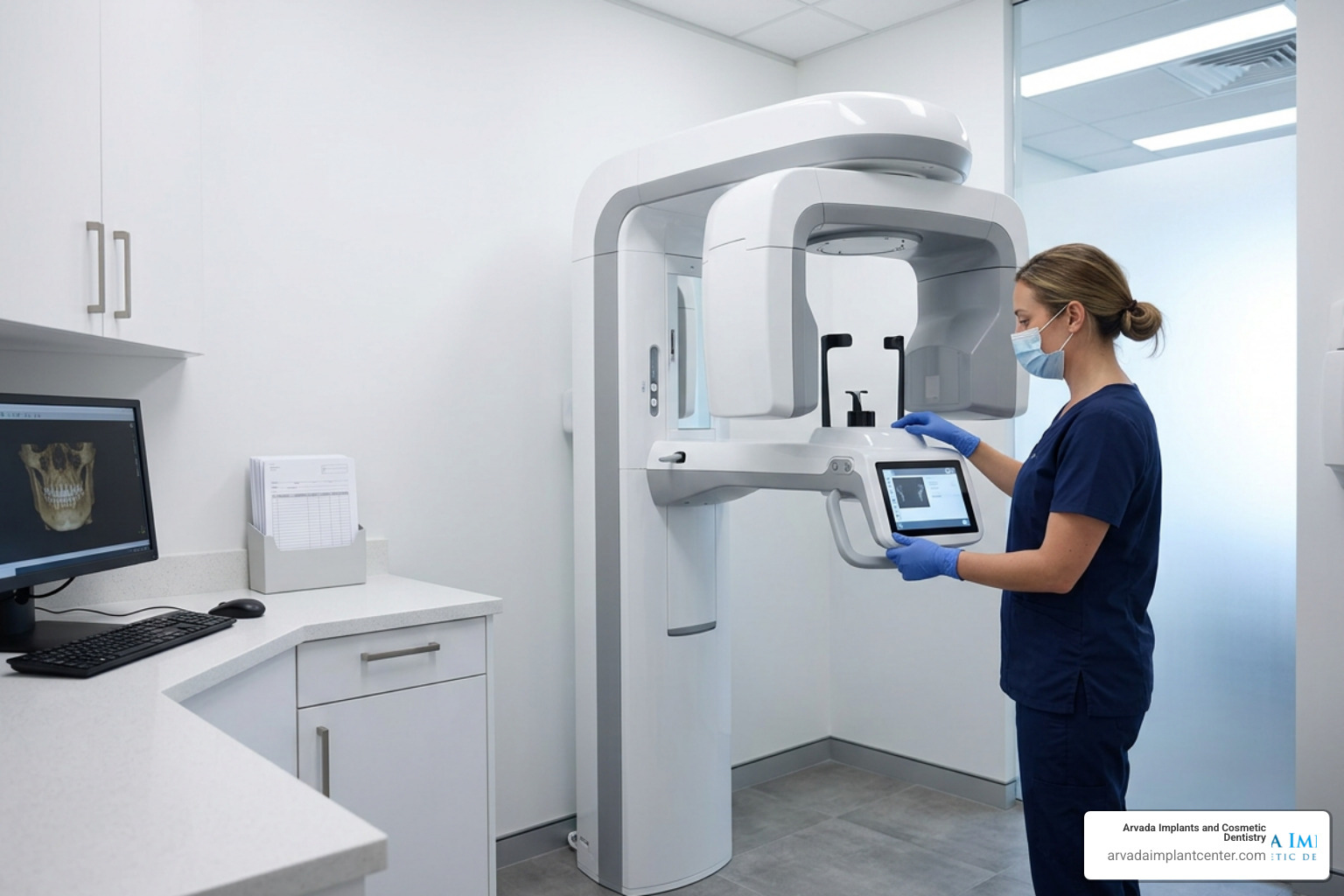
While surface scans are sufficient for manufacturing basic clear aligner trays, they do not provide the anatomical data needed to plan complex tooth movements safely. A separate CBCT clear aligner 3D imaging fee is charged because of the specialized medical-grade equipment and advanced clinical interpretation required to analyze the 3D X-ray.
By integrating CBCT data into your aligner setup, we can:
Prevent Root Resorption: If a tooth root is pushed against dense bone or an adjacent tooth root, the body may begin to reabsorb the root, shortening it and weakening the tooth.
Evaluate the Sinus Floor: The roots of your upper molars often sit very close to, or even inside, your sinus cavity. CBCT scans help us avoid moving teeth into areas that could compromise your sinuses.
Assess Airway Volume: 3D imaging can identify airway restrictions, allowing us to plan orthodontic movements that support healthier breathing and sleep patterns.
How Much Does 3D Imaging for Clear Aligners Cost?
In 2026, the national average cost of clear aligners ranges from $1,500 for minor cosmetic corrections to upwards of $8,000 for highly complex cases. Within that range, diagnostic records — which include 3D digital scans, clinical photographs, and traditional X-rays — typically carry a standalone value of $200 to $500 if billed separately.
How much you actually pay for your 3D imaging depends heavily on the billing structure of the dental office you choose.
Bundled vs. Unbundled Clear Aligner 3D Imaging Fee Structures
When comparing orthodontic quotes in the Arvada or Denver metro areas, you will generally run into two different pricing philosophies:
Bundled (All-Inclusive) Pricing: Under this model, the provider quotes you a single global fee that covers your initial consultation, 3D scans, all aligner trays, refinement trays, and your final post-treatment retainers. For example, a comprehensive quote of $5,000 includes everything from start to finish.
Unbundled (Itemized) Pricing: Under this model, the provider breaks down every individual service. While the base price for the aligner trays might look lower upfront (e.g., $3,200), you will pay separate, unbundled fees for your initial 3D scan ($140 to $200), refinement scans ($150 each), and retainers ($300 to $500).
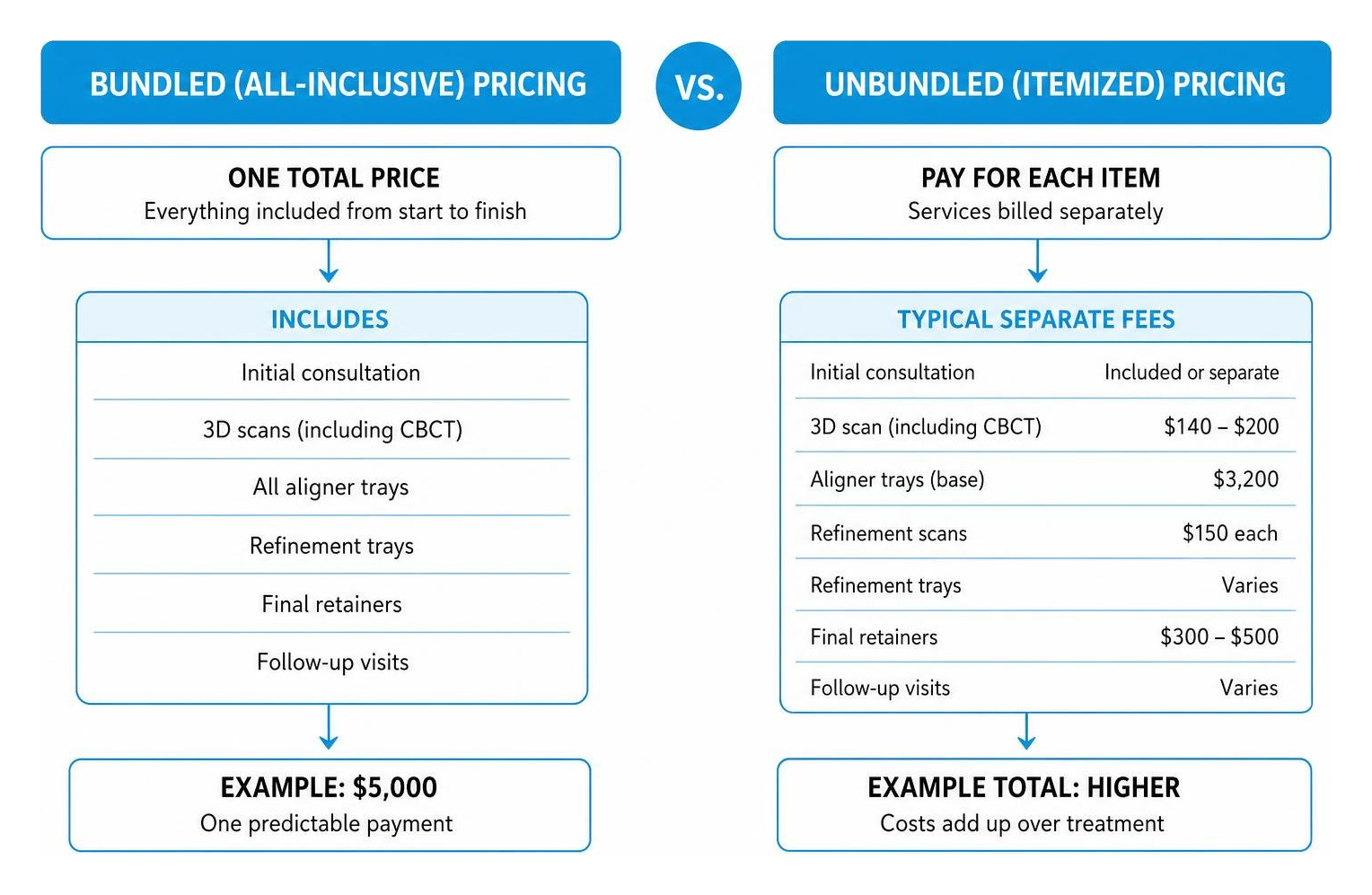
Unbundled pricing isn't inherently bad, but it can lead to "sticker shock" if you aren't prepared. This is why we always recommend requesting an itemized quote listing trays, refinements, retainers, and follow-up visits separately. If you are concerned about managing these upfront costs, look for a practice that offers flexible payment plans to break your treatment into manageable monthly installments.
The Value of Advanced 3D Imaging vs. Traditional Physical Impressions
Is paying a 3D imaging fee actually worth it compared to older, traditional methods? Absolutely.
Traditional physical impressions rely on plaster molds that can warp, tear, or bubble. If a physical mold is slightly inaccurate, your clear aligners will not fit properly, leading to delayed treatment times and poor results. Furthermore, standard 2D X-rays distort anatomical structures, making it impossible to see the true 3-dimensional relationship between your teeth, roots, and jawbone.
Advanced 3D imaging eliminates this guesswork. By capturing your smile with sub-10-micron accuracy, digital scans reduce clear aligner remake rates to as low as 2.1%. This precision ensures your clear aligners track exactly as planned, saving you precious time in the dental chair and delivering a more comfortable, predictable result.
Insurance, FSA, and HSA Coverage for 3D Imaging
Navigating dental insurance can feel overwhelming, but when it comes to clear aligners and 3D imaging, there are several ways to make your treatment more affordable.
Many dental insurance plans in 2026 include an orthodontic benefit, which typically covers 50% of the allowed treatment cost up to a lifetime maximum of $1,000 to $3,000.
Here is what you need to know about how insurance handles the clear aligner 3D imaging fee:
The Orthodontic CDT Code: Insurance companies process clear aligner claims using standard orthodontic codes (usually D8010 through D8090). If your provider bundles the 3D scan into the global orthodontic fee, the cost of the scan is covered under your lifetime orthodontic maximum.
Standalone Diagnostic Codes: If your provider bills the 3D imaging unbundled, they may use diagnostic codes such as D0330 (panoramic film) or D0350 (2D oral/facial images). Some PPO plans cover diagnostic records at 80% to 100% as part of your annual preventative care, meaning you may pay very little out-of-pocket for the scan itself.
To help you maximize your benefits, we recommend speaking with an expert in insurance and finance who can submit a pre-determination to your insurance carrier before your treatment begins.
Using FSA and HSA Funds
Because clear aligners are designed to improve both the function and alignment of your bite, they are classified as an IRS-qualified medical expense. This means you can use your Flexible Spending Account (FSA) or Health Savings Account (HSA) to pay for both your clear aligners and any associated 3D imaging fees using tax-free dollars.
Tip: Because orthodontic treatment spans multiple months, many patients maximize their tax savings by starting treatment in December. This allows them to split their payments across two different FSA plan years, utilizing their pre-tax contributions from both years to cover the balance.
Frequently Asked Questions about Clear Aligner Costs
To help you make an informed decision, we have compiled answers to some of the most common questions we hear from patients in Arvada, CO.
Are refinement and retainer scans included in the initial fee?
It depends entirely on your provider. If your teeth do not track perfectly according to the original digital simulation, you may need a "refinement" or mid-course correction. This requires taking a new 3D scan to manufacture a set of supplemental trays.
In a bundled pricing structure, refinement scans and your first set of post-treatment retainers are usually included. In an unbundled structure, a refinement scan can add an extra $150 per scan, and retainers can cost $300 to $500. Be sure to review your clear aligner home care instructions to keep your teeth tracking properly and minimize the need for extra refinement scans.
Can I get a 3D scan without committing to full treatment?
Yes. Many offices offer an initial consultation where they perform a 3D digital scan to generate a smile simulation. This allows you to see what your teeth could look like after treatment before you invest in the full clear aligner package. If you decide not to proceed, you may only be responsible for a nominal diagnostic records fee (typically $100 to $200).
Does dental insurance cover 3D imaging separately?
In most cases, if the 3D scan is performed strictly for orthodontic planning, it is applied toward your lifetime orthodontic maximum. However, if the scan is a CBCT 3D X-ray used to diagnose a separate issue (such as TMJ dysfunction, impacted teeth, or bone pathology), your insurance may cover it under your standard restorative diagnostic benefits.
Conclusion
When deciding if the clear aligner 3D imaging fee is worth it, the answer is a resounding yes. Advanced 3D imaging is the biological and mechanical foundation of modern orthodontics. It ensures your teeth are moved safely within their bone boundaries, eliminates the discomfort of messy physical impressions, and drastically reduces the risk of treatment errors.
At Arvada Implants and Cosmetic Dentistry, we pride ourselves on providing affordable, personalized treatments with custom lab creations tailored to your unique smile. We never want hidden fees to stand between you and your dream smile, which is why we provide complete cost transparency from day one.
If you are ready to see what advanced digital dentistry can do for your smile, Schedule a consultation for a clear aligner today. Our experienced team is here to help you explore your options in clear aligners and cosmetic dentistry in a warm, judgment-free environment. For more information on orthodontic standards and patient safety, you can also visit the American Association of Orthodontists.